


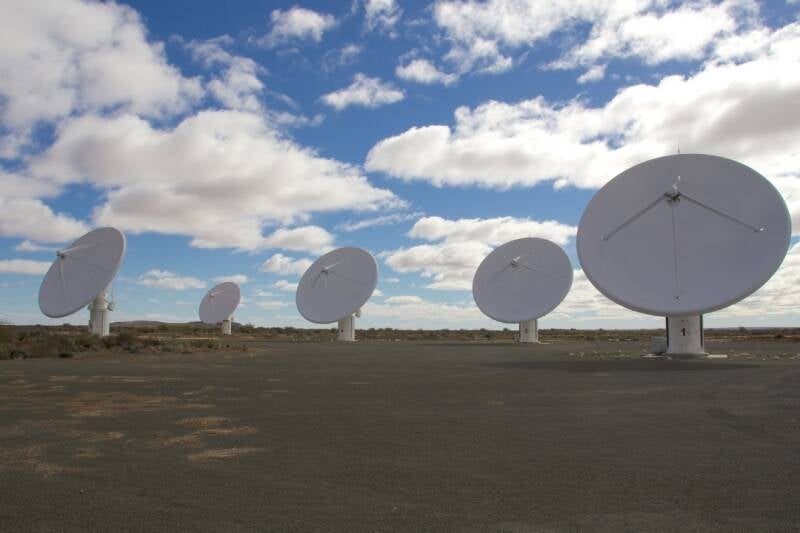
The Square Kilometre Array (SKA) is the largest radio astronomy project ever constructed a distributed radio telescope spanning South Africa & Australia, comprising:
~200 mid‑frequency dishes (SKA‑Mid)
~130,000 low‑frequency antennas (SKA‑Low)
Designed to deliver transformational insights into cosmic evolution, dark energy & the early universe it's scientific mission depends on exabyte‑scale Big Data generation & transport across thousands of kilometres of fibre‑optic infrastructure.
Global Science Data Centres (SDCs) across multiple continents & will generate up to 8 Tb/s of raw sensor data, 2–3 Tb/s post‑correlation transport, 600 PB/year of scientific archive data in Phase 1, scaling to multi‑exabyte volumes in Phase 2.
This is an overview of the passive and active fibre‑optic technologies that underpin the SKA’s data architecture, including single‑mode fibre systems, DWDM transport, coherent optical transceivers, precision timing distribution & future photonic switching.
Fibre optics are clearly essential for achieving the SKA’s bandwidth, latency, synchronisation as well as long‑haul transport requirements:
Big Data Challenges in the SKA
1 Extreme Data Volume
2 Latency & Synchronisation
3 Environmental Constraints
4 Remote deployment with limited maintenance access
5 Long‑Term Scalability
The SKA’s 50‑year lifespan requires fibre systems supporting:
100G → 400G → 800G → 1.6T evolution
Photonic switching & Quantum‑grade timing distribution
Passive Fibre Infrastructure is designed for low attenuation, long‑distance performance, and compatibility with coherent optics.
Used for wavelength routing, timing distribution, monitoring taps & redundancy.
Active Optical Components include DWDM transport, coherent optical transceivers & optical amplification
Timing systems include:
White Rabbit, optical frequency transfer & stabilised laser distribution & photonic switching
Future phases will incorporate ROADM‑based switching & photonic mesh networks.
End‑to‑End Fibre Architecture
1 Antenna → Local Processing Node
2 Local Node → Regional Correlator
3 Correlator → Global Science Data Centres
4 Timing Distribution
Stabilised laser over SMF with bidirectional delay calibration
Why are Fibre Optics Essential?
Copper cannot meet operational criteria.
Future Fibre Technologies for SKA Phase 2
800G ZR/ZR+ coherent optics, Hollow‑core fibre (HCF)
Quantum timing distribution, photonic integrated circuits (PICs)
Terabit DWDM channels
The SKA’s scientific mission depends fundamentally on fibre‑optic technology. Passive cabling, coherent optics, DWDM transport, precision timing systems & future photonic switching collectively enable the observatory’s exabyte‑scale Big Data pipeline.
Fibre optics are the critical infrastructure that transforms cosmic radio signals into scientific discovery.
~200 mid‑frequency dishes (SKA‑Mid)
~130,000 low‑frequency antennas (SKA‑Low)
Designed to deliver transformational insights into cosmic evolution, dark energy & the early universe it's scientific mission depends on exabyte‑scale Big Data generation & transport across thousands of kilometres of fibre‑optic infrastructure.
Global Science Data Centres (SDCs) across multiple continents & will generate up to 8 Tb/s of raw sensor data, 2–3 Tb/s post‑correlation transport, 600 PB/year of scientific archive data in Phase 1, scaling to multi‑exabyte volumes in Phase 2.
This is an overview of the passive and active fibre‑optic technologies that underpin the SKA’s data architecture, including single‑mode fibre systems, DWDM transport, coherent optical transceivers, precision timing distribution & future photonic switching.
Fibre optics are clearly essential for achieving the SKA’s bandwidth, latency, synchronisation as well as long‑haul transport requirements:
Big Data Challenges in the SKA
1 Extreme Data Volume
2 Latency & Synchronisation
3 Environmental Constraints
4 Remote deployment with limited maintenance access
5 Long‑Term Scalability
The SKA’s 50‑year lifespan requires fibre systems supporting:
100G → 400G → 800G → 1.6T evolution
Photonic switching & Quantum‑grade timing distribution
Passive Fibre Infrastructure is designed for low attenuation, long‑distance performance, and compatibility with coherent optics.
Used for wavelength routing, timing distribution, monitoring taps & redundancy.
Active Optical Components include DWDM transport, coherent optical transceivers & optical amplification
Timing systems include:
White Rabbit, optical frequency transfer & stabilised laser distribution & photonic switching
Future phases will incorporate ROADM‑based switching & photonic mesh networks.
End‑to‑End Fibre Architecture
1 Antenna → Local Processing Node
2 Local Node → Regional Correlator
3 Correlator → Global Science Data Centres
4 Timing Distribution
Stabilised laser over SMF with bidirectional delay calibration
Why are Fibre Optics Essential?
Copper cannot meet operational criteria.
Future Fibre Technologies for SKA Phase 2
800G ZR/ZR+ coherent optics, Hollow‑core fibre (HCF)
Quantum timing distribution, photonic integrated circuits (PICs)
Terabit DWDM channels
The SKA’s scientific mission depends fundamentally on fibre‑optic technology. Passive cabling, coherent optics, DWDM transport, precision timing systems & future photonic switching collectively enable the observatory’s exabyte‑scale Big Data pipeline.
Fibre optics are the critical infrastructure that transforms cosmic radio signals into scientific discovery.
Add comment
Comments